Which is the Best AI Detector in 2026 to Catch GPT-5 and Claude 4.7?
Artificial intelligence has changed how people write, learn, and publish content. Large language models such as GPT-5 and Claude 4.7 can now produce writing that is often difficult to distinguish from human-created text. As a result, AI detectors have become increasingly important for educators, publishers, businesses, recruiters, and content platforms.
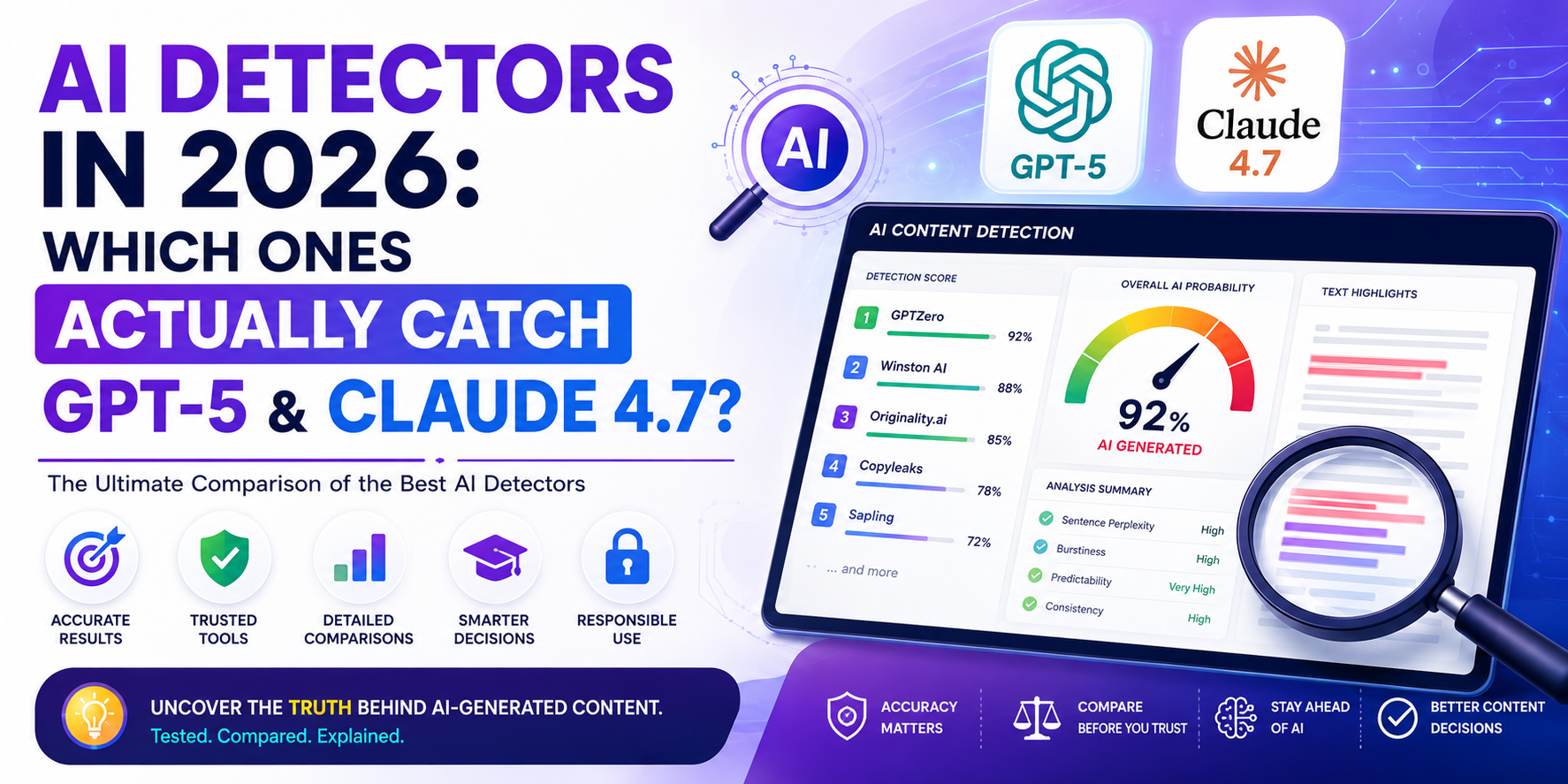
But one question keeps coming up: Can AI detectors actually identify GPT-5 and Claude 4.7 content accurately? The short answer is sometimes.
Modern AI detectors have improved significantly, but none can guarantee perfect accuracy. Even the best platforms occasionally produce false positives, especially when evaluating polished human writing or AI-generated content that has been heavily edited.
In this guide, we’ll explain how AI detectors work, compare the leading AI detection tools, discuss their strengths and limitations, and help you choose the right solution based on your workflow.
Whether you’re a teacher checking student assignments, an editor reviewing submissions, or a business verifying content authenticity, understanding the capabilities and limitations of AI detection software is more important than ever.
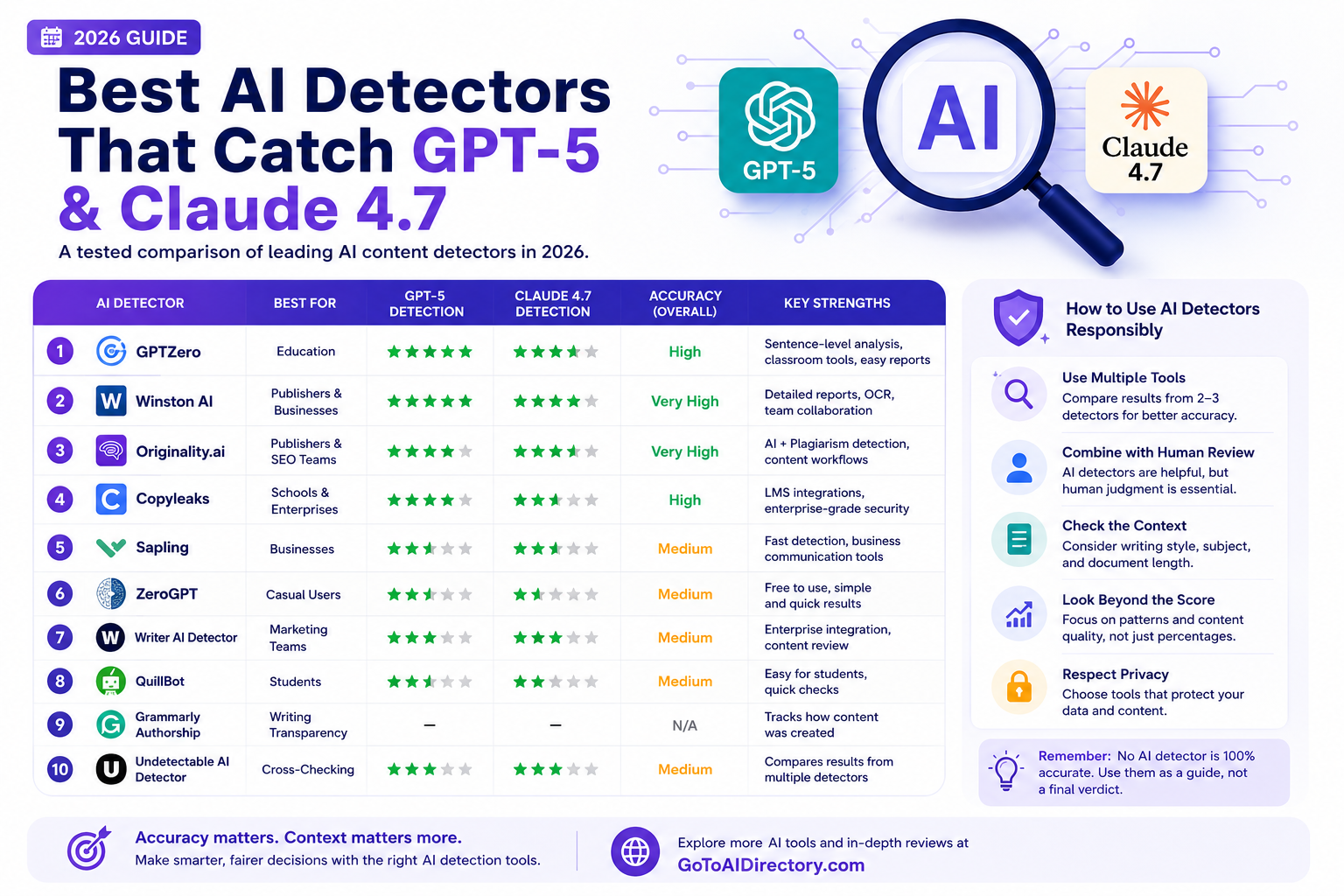
Quick Comparison: Best AI Detectors in 2026
| AI Detector | Best For | Accuracy* | File Uploads | API | Best Use Case |
|---|---|---|---|---|---|
| GPTZero | Education | ★★★★★ | ✓ | ✓ | Teachers & Universities |
| Winston AI | Publishers | ★★★★★ | ✓ | ✓ | Businesses & Agencies |
| Originality.ai | Publishers | ★★★★★ | ✓ | ✓ | Website Content |
| Copyleaks | Enterprise | ★★★★☆ | ✓ | ✓ | Schools & Companies |
| Sapling AI Detector | Business | ★★★★☆ | ✓ | ✓ | Customer Support |
| ZeroGPT | Casual Checks | ★★★☆☆ | ✓ | Limited | General Users |
| Writer AI Detector | Marketing | ★★★☆☆ | ✗ | Limited | Marketing Teams |
| QuillBot AI Detector | Students | ★★★☆☆ | ✗ | ✗ | Basic Detection |
| Grammarly Authorship | Writing History | N/A | N/A | N/A | Google Docs Users |
| Undetectable AI Detector | Cross-checking | ★★★☆☆ | ✓ | Limited | Multiple Detector Comparison |
*Accuracy varies depending on writing style, editing, prompt complexity, and the AI model used. No detector currently guarantees 100% accuracy.
How Do AI Detectors Work?
Many people assume AI detectors look for hidden markers inside AI-generated text.
They do not.
Instead, most modern AI detectors rely on statistical models that analyze linguistic patterns commonly found in machine-generated writing.
Some of the factors detectors evaluate include:
- Sentence structure
- Predictability of word choices
- Repetition
- Burstiness
- Perplexity
- Grammar consistency
- Vocabulary distribution
- Writing rhythm
- Semantic patterns
Rather than declaring a document “AI” or “human,” detectors calculate the probability that a piece of writing resembles machine-generated content.
This is why two different detectors may produce different results for the same article.
Can AI Detectors Really Detect GPT-5 and Claude 4.7?
This is where things become more complicated. Earlier AI models often produced writing with repetitive sentence structures, predictable phrasing, and limited stylistic variation. These patterns made detection easier. GPT-5 and Claude 4.7 produce far more natural writing.
They vary sentence length, adjust tone, maintain context over long documents, and generate content that resembles experienced human writers. As a result:
✅ Detection has become more difficult.
✅ Different detectors disagree more frequently.
✅ Human editing significantly reduces detection confidence.
Several independent evaluations published during 2026 found that the highest-performing AI detectors generally identified obvious AI-generated content with good accuracy, but performance dropped noticeably once the text had been revised or blended with human edits. This reinforces the idea that AI detector scores should be treated as indicators rather than definitive proof.
Why AI Detectors Sometimes Get It Wrong
False positives remain one of the biggest challenges in AI detection. A false positive occurs when a detector labels human-written content as AI-generated. This can happen when:
- Academic writing is highly structured.
- Technical documentation follows consistent formatting.
- Non-native English speakers write with simpler sentence structures.
- Professional editors produce very polished content.
False negatives are also common. If AI-generated content has been substantially edited by a human, many detectors struggle to identify its origin with confidence. Because of these limitations, most universities and publishers recommend combining AI detection with human review instead of relying solely on detector scores.
Tip: Never make important academic or publishing decisions based on a single AI detector result. Cross-check suspicious content using multiple tools and review the writing manually.
What Makes a Good AI Detector?
Not every AI detector is designed for the same audience. When comparing AI detection software, consider the following factors:
| Evaluation Factor | Why It Matters |
|---|---|
| Detection Accuracy | Higher accuracy reduces false positives and false negatives. |
| Transparency | Good detectors explain why content was flagged. |
| Language Support | Important for multilingual users. |
| File Uploads | Useful for educators and editors reviewing documents. |
| API Access | Enables workflow automation for businesses. |
| Speed | Large organizations often process thousands of documents daily. |
| Privacy | Uploaded documents should be handled securely. |
The best AI detector is not necessarily the one with the highest detection score. It is the one that fits your workflow while providing consistent, explainable results.
1. GPTZero
Best AI Detector for Education
GPTZero remains one of the most widely recognized AI detection platforms, particularly in education. Originally developed to help teachers identify AI-generated assignments, the platform has expanded into a comprehensive detection solution used by universities, publishers, and businesses.
Rather than providing only a simple percentage score, GPTZero highlights individual sentences that appear likely to have been generated by AI. This allows reviewers to investigate specific sections instead of treating an entire document as suspicious.
Another strength is its document management features, which support classroom workflows through file uploads, batch scanning, and integrations with learning platforms.
Although GPTZero performs well on straightforward AI-generated text, it is not immune to false positives, especially when evaluating highly structured academic writing or heavily edited AI content.
Key Features
- AI content detection
- Sentence-level highlighting
- File uploads
- Batch document scanning
- Classroom integrations
- API access
- Writing reports
Pros
- Strong educational focus
- Easy-to-understand reports
- Good document management
- Widely adopted by educators
Cons
- False positives remain possible
- Edited AI content is more difficult to detect
Best For
Teachers, universities, academic institutions, and educational publishers.
2. Winston AI
Best AI Detector for Publishers and Businesses
Winston AI has become one of the leading AI detection platforms for professional publishing workflows. It is widely used by content agencies, website owners, marketing teams, and businesses that need to verify content authenticity before publication.
The platform supports multiple document formats, OCR for scanned documents, and detailed AI detection reports. Winston AI also emphasizes privacy, making it suitable for organizations handling sensitive business content.
Compared with many free AI detectors, Winston AI generally provides more detailed reporting and workflow features that benefit professional teams.
Key Features
- AI detection
- OCR support
- File uploads
- Batch processing
- API access
- Team collaboration
- Reporting dashboard
Pros
- Strong business workflows
- Detailed reports
- Good document compatibility
- Suitable for agencies
Cons
- Premium features require a subscription
- Detection accuracy still depends on writing style
Best For
Publishers, agencies, businesses, and professional content teams.
3. Originality.ai
Best AI Detector for Website Publishers
Originality.ai is one of the most popular AI detectors among website publishers, SEO agencies, and editorial teams. In addition to AI detection, the platform includes plagiarism detection and readability tools, making it particularly useful for websites that publish large volumes of content.
One of Originality.ai’s strengths is its focus on publishing workflows. Teams can scan articles before publication, monitor content quality, and review AI detection reports alongside plagiarism results.
Because it combines multiple quality assurance tools into one platform, it has become a common choice for businesses managing outsourced content or freelance contributors.
Key Features
- AI detection
- Plagiarism checking
- Team management
- Website publishing workflows
- API
- Batch scanning
- Content reports
Pros
- Excellent for publishers
- Combines plagiarism and AI detection
- Team collaboration features
- Suitable for agencies
Cons
- Premium platform
- Detection scores should still be interpreted carefully
Best For
Website owners, SEO agencies, publishers, editorial teams, and businesses managing large content libraries.
4. Copyleaks
Best AI Detector for Schools and Enterprises
Copyleaks is one of the most established AI detection platforms and is widely used by schools, universities, publishers, and enterprise organizations. Unlike tools designed primarily for individual users, Copyleaks focuses on large-scale document verification, offering integrations with learning management systems and business workflows.
The platform analyzes writing patterns to estimate whether text is likely to have been generated by AI models. It also includes plagiarism detection, making it useful for academic integrity and content quality assurance.
Independent testing has shown that Copyleaks performs well on clearly AI-generated content. Like other detectors, however, its confidence decreases when content has been heavily edited or blended with human writing.
Key Features
- AI content detection
- Plagiarism detection
- LMS integrations
- API access
- Batch document scanning
- Enterprise dashboard
- Multilingual support
Pros
- Strong enterprise capabilities
- Excellent educational integrations
- Reliable reporting
- Supports multiple languages
Cons
- More expensive than casual-use tools
- AI scores should not be treated as definitive evidence
Best For
Universities, schools, enterprise organizations, and compliance teams.
5. Sapling AI Detector
Best AI Detector for Business Writing
Sapling is best known for its AI writing assistant, but it also offers an AI content detector aimed at businesses and customer support teams.
The detector is designed for quick evaluations rather than detailed academic investigations. Users can paste text into the interface and receive an estimate of how likely it is to have been AI generated.
Because Sapling focuses heavily on business communication, it is commonly used by organizations reviewing customer support responses, internal documentation, and marketing content.
Key Features
- AI detection
- Browser integration
- Business workflows
- Fast analysis
- API access
- Grammar assistance
Pros
- Fast processing
- Easy to use
- Helpful for business communication
- Good workflow integration
Cons
- Less detailed reporting than education-focused platforms
- Limited publishing features
Best For
Businesses, customer support teams, and marketing departments.
6. ZeroGPT
Best Free AI Detector for Casual Use
ZeroGPT has become one of the most widely used free AI detectors due to its accessibility and straightforward interface. Users simply paste text into the editor and receive an AI probability score.
Its simplicity makes it popular among students, bloggers, and general users who want a quick indication of whether content may appear AI generated.
While ZeroGPT is useful for basic screening, independent comparisons often show greater variability than premium platforms, particularly with edited AI content and sophisticated language models.
Key Features
- AI probability scoring
- Simple interface
- Multiple language support
- Free access
- Sentence highlighting
Pros
- Easy to use
- Accessible free version
- Quick results
- Suitable for casual checks
Cons
- Less consistent than premium detectors
- Limited reporting capabilities
Best For
Students, bloggers, freelancers, and casual users.
7. Writer AI Detector
Best AI Detector for Marketing Teams
Writer offers an AI detector alongside its enterprise writing platform. Rather than targeting educators, Writer focuses on helping businesses review marketing content, product documentation, and internal communications.
The detector provides a simple probability estimate and integrates naturally with Writer’s broader content platform.
Organizations already using Writer for content generation often appreciate having AI detection within the same ecosystem.
Key Features
- AI detection
- Enterprise integration
- Business workflows
- Content review
- Team collaboration
Pros
- Clean interface
- Good enterprise integration
- Suitable for marketing teams
Cons
- Limited standalone functionality
- Less detailed analysis than dedicated detectors
Best For
Marketing teams, enterprise organizations, and content operations.
8. QuillBot AI Detector
Best AI Detector for Students
QuillBot is widely recognized for paraphrasing and grammar tools, and its AI detector extends the platform’s educational focus.
Students can quickly check essays or assignments before submission, while educators may use it as a secondary screening tool.
Its straightforward interface makes it easy to use, although advanced reporting and workflow features are more limited than enterprise-focused platforms.
Key Features
- AI detection
- Simple interface
- Educational focus
- Browser accessibility
- Fast scanning
Pros
- Beginner friendly
- Easy to access
- Useful alongside QuillBot’s writing tools
Cons
- Basic reporting
- Limited enterprise capabilities
Best For
Students, tutors, and individual writers.
9. Grammarly Authorship
Best for Tracking Writing History
Grammarly Authorship approaches AI verification differently from traditional AI detectors.
Instead of attempting to determine whether finished text is AI generated, it records how content was created. The feature identifies whether text was typed manually, pasted from another source, or generated using Grammarly’s AI features.
Because it focuses on writing history rather than probability scoring, Grammarly Authorship offers an additional layer of transparency for educational and professional workflows.
Key Features
- Writing history
- Authorship tracking
- Document timeline
- AI contribution indicators
- Grammarly integration
Pros
- Different approach to verification
- Helpful for academic transparency
- Integrated into Grammarly workflows
Cons
- Not a traditional AI detector
- Limited to supported writing environments
Best For
Students, educators, and professionals using Grammarly.
10. Undetectable AI Detector
Best for Comparing Multiple AI Detectors
Undetectable AI is known primarily for AI humanization tools, but it also includes an AI detector that compares results from multiple detection systems.
Instead of relying on a single model, users can see how different detectors evaluate the same piece of text. This broader perspective helps explain why AI detection results often vary.
While it should not replace dedicated enterprise detectors, it provides useful secondary validation when reviewing important documents.
Key Features
- Multi-detector comparison
- AI probability analysis
- Humanization tools
- Content reports
- Browser interface
Pros
- Compare multiple detector results
- Useful secondary opinion
- Simple interface
Cons
- Results depend on external detector models
- Better suited as a supplemental tool
Best For
Content creators, editors, and users who want multiple AI detection opinions.
Detection Accuracy Comparison
| Tool | GPT-5 Detection | Claude 4.7 Detection | False Positive Risk | Overall Recommendation |
|---|---|---|---|---|
| GPTZero | High | Medium | Medium | Excellent for education |
| Winston AI | High | High | Medium | Best overall business choice |
| Originality.ai | High | High | Medium | Excellent for publishers |
| Copyleaks | High | Medium | Medium | Strong enterprise option |
| Sapling | Medium | Medium | Medium | Business workflows |
| ZeroGPT | Medium | Low | Higher | Casual use |
| Writer | Medium | Medium | Medium | Enterprise content |
| QuillBot | Medium | Low | Medium | Students |
| Grammarly Authorship | Different approach | Different approach | Low | Writing transparency |
| Undetectable AI | Depends on detector | Depends on detector | Varies | Secondary verification |
Important: No independent testing has shown any AI detector to consistently identify GPT-5 or Claude 4.7 with perfect accuracy. Results vary based on prompts, editing, writing style, and document length.
Why Do AI Detectors Disagree?
Many users are surprised when one detector flags content as AI while another classifies the same text as human.
This happens because each platform uses its own machine learning models, scoring methods, thresholds, and training datasets.
Factors influencing results include:
- Sentence complexity
- Editing after AI generation
- Writing style
- Document length
- Language
- Prompt quality
For this reason, experienced editors rarely rely on a single AI detector when evaluating important content.
Best Practice: When reviewing academic papers or published articles, compare results from at least two or three reputable AI detectors before drawing conclusions.
Tips for Getting More Reliable AI Detection Results
- Analyze complete documents instead of isolated paragraphs.
- Use multiple AI detectors when accuracy matters.
- Treat AI scores as indicators rather than proof.
- Combine automated detection with manual review.
- Consider the writing context before making decisions.
- Remember that polished human writing can sometimes trigger false positives.
AI detection technology continues to improve, but human judgment remains an essential part of responsible content evaluation.
Best AI Detectors by Use Case
Not every AI detector is built for the same audience. Some platforms prioritize education, while others are designed for publishers, enterprises, or individual content creators.
The table below summarizes our recommendations based on different use cases.
| Use Case | Recommended AI Detector | Why It Stands Out |
|---|---|---|
| Best Overall AI Detector | Winston AI | Balanced accuracy, detailed reports, and business-friendly workflows |
| Best AI Detector for Teachers | GPTZero | Designed specifically for educational institutions with sentence-level analysis |
| Best AI Detector for Publishers | Originality.ai | Combines AI detection with plagiarism checking and team management |
| Best Enterprise AI Detector | Copyleaks | Strong integrations, multilingual support, and enterprise features |
| Best AI Detector for Students | QuillBot AI Detector | Simple interface for quick assignment checks |
| Best Free AI Detector | ZeroGPT | Easy to access and suitable for basic AI detection |
| Best AI Detector for Marketing Teams | Writer AI Detector | Integrates with enterprise writing workflows |
| Best AI Detector for Business Documents | Sapling | Fast detection and business-focused integrations |
| Best Writing Transparency Tool | Grammarly Authorship | Tracks how documents were created instead of estimating AI probability |
| Best Multi-Detector Comparison | Undetectable AI | Compares results from several AI detection models |
Should Teachers Trust AI Detectors?
Educational institutions have rapidly adopted AI detection software, but experts generally agree that detector scores should not be used as the sole basis for academic decisions.
Most universities recommend treating AI detection as one piece of evidence rather than definitive proof.
Best Practices for Educators
- Review the student’s previous writing style.
- Compare detector results across multiple platforms.
- Look for inconsistencies in writing quality.
- Discuss suspicious submissions with the student.
- Consider document revision history where available.
Using AI detectors responsibly helps reduce the risk of false accusations while maintaining academic integrity.
Tips for Publishers and Editors
Publishers face a different challenge than educators.
The goal is often not to prohibit AI use entirely, but to ensure that published content is accurate, original, and provides genuine value to readers.
When reviewing articles:
Use AI Detectors as a Quality Check
AI detection should complement, not replace, editorial review.
Verify Facts Independently
Even if content appears human-written, factual accuracy should always be confirmed using reliable sources.
Review Writing Style
Articles that contain repetitive wording, generic explanations, or shallow insights often benefit from additional editing regardless of whether they were AI generated.
Focus on Value
Google’s Search Quality guidelines emphasize helpful, people-first content. Whether an article was written by a human or with AI assistance is less important than whether it demonstrates expertise, originality, and usefulness.
AI Detection and Google Search
A common misconception is that Google penalizes AI-generated content automatically.
This is not the case.
Google has repeatedly stated that it evaluates content based on quality rather than the method used to create it.
Content that is accurate, original, helpful, and demonstrates expertise can perform well in search results whether it was written entirely by humans, created with AI assistance, or produced using a combination of both.
This means AI detectors should primarily be viewed as tools for content verification and workflow management rather than indicators of search performance.
How AI Search Engines View AI-Generated Content
Modern AI search platforms such as ChatGPT Search, Google AI Overviews, Gemini, Claude, and Perplexity prioritize:
- Accurate information
- Trustworthy sources
- Clear structure
- Comprehensive explanations
- Well-organized comparisons
- Educational content
- Updated information
Simply rewriting AI-generated text to “beat” an AI detector is unlikely to improve visibility in AI-powered search experiences.
Instead, focus on creating content that demonstrates expertise, provides original insights, and answers user questions thoroughly.
Can You Fool AI Detectors?
Some services claim they can rewrite AI-generated content so that it consistently bypasses AI detectors.
While editing can reduce the likelihood of detection, there is no guaranteed method that works across every detector.
As detection models continue to evolve, strategies that work today may become less effective over time.
More importantly, attempting to bypass AI detectors is generally less valuable than producing high-quality, transparent content that genuinely serves readers.
Final Thoughts
AI detectors have become valuable tools for educators, publishers, businesses, and content teams, but they are far from perfect.
Platforms such as GPTZero, Winston AI, and Originality.ai consistently rank among the strongest options because they combine robust detection capabilities with practical workflows and detailed reporting. However, even these leading solutions occasionally produce incorrect results.
The most effective approach is to view AI detectors as decision-support tools rather than final judges. Combining multiple detectors, reviewing content manually, verifying facts, and considering the broader context will almost always lead to better outcomes than relying on a single AI probability score.
As language models like GPT-5 and Claude 4.7 continue to improve, AI detection technology will also evolve. For now, transparency, editorial oversight, and thoughtful review remain the best practices for maintaining content quality and integrity.
If you’re exploring AI detectors, AI writing assistants, SEO tools, or productivity software, visit GoToAI Directory to discover and compare hundreds of AI tools across categories, helping you choose the right solution for your workflow.
Frequently Asked Questions
What is the best AI detector in 2026?
GPTZero, Winston AI, and Originality.ai are among the most reliable AI detectors available in 2026. The best choice depends on your workflow. GPTZero is widely used in education, Winston AI is well suited for businesses, and Originality.ai is popular among publishers and SEO agencies.
Can AI detectors detect GPT-5?
Current AI detectors can often identify fully AI-generated GPT-5 content, but accuracy decreases when the content has been edited by humans or combined with original writing. No AI detector currently guarantees perfect GPT-5 detection.
Can AI detectors detect Claude 4.7?
Claude 4.7 produces highly natural writing, making detection more challenging. Most leading AI detectors can identify some Claude-generated content, but confidence levels vary significantly depending on editing and writing style.
Are AI detectors accurate?
AI detectors have improved considerably, but they are not 100% accurate. Both false positives and false negatives remain common, particularly with edited AI-generated text and polished human writing.
Which AI detector is best for teachers?
GPTZero is one of the most widely adopted AI detectors in education because of its classroom-focused features, sentence-level analysis, and document management capabilities.
Which AI detector is best for publishers?
Originality.ai is a strong choice for publishers because it combines AI detection, plagiarism checking, and team management tools designed for editorial workflows.
Can AI detectors identify paraphrased AI content?
Detection becomes more difficult after significant human editing or paraphrasing. Most AI detectors perform best on content that has been generated directly by AI with minimal revision.
Should AI detector scores be treated as proof?
No. AI detector scores are estimates based on statistical patterns. They should be interpreted alongside manual review, contextual information, and other evidence rather than treated as definitive proof.