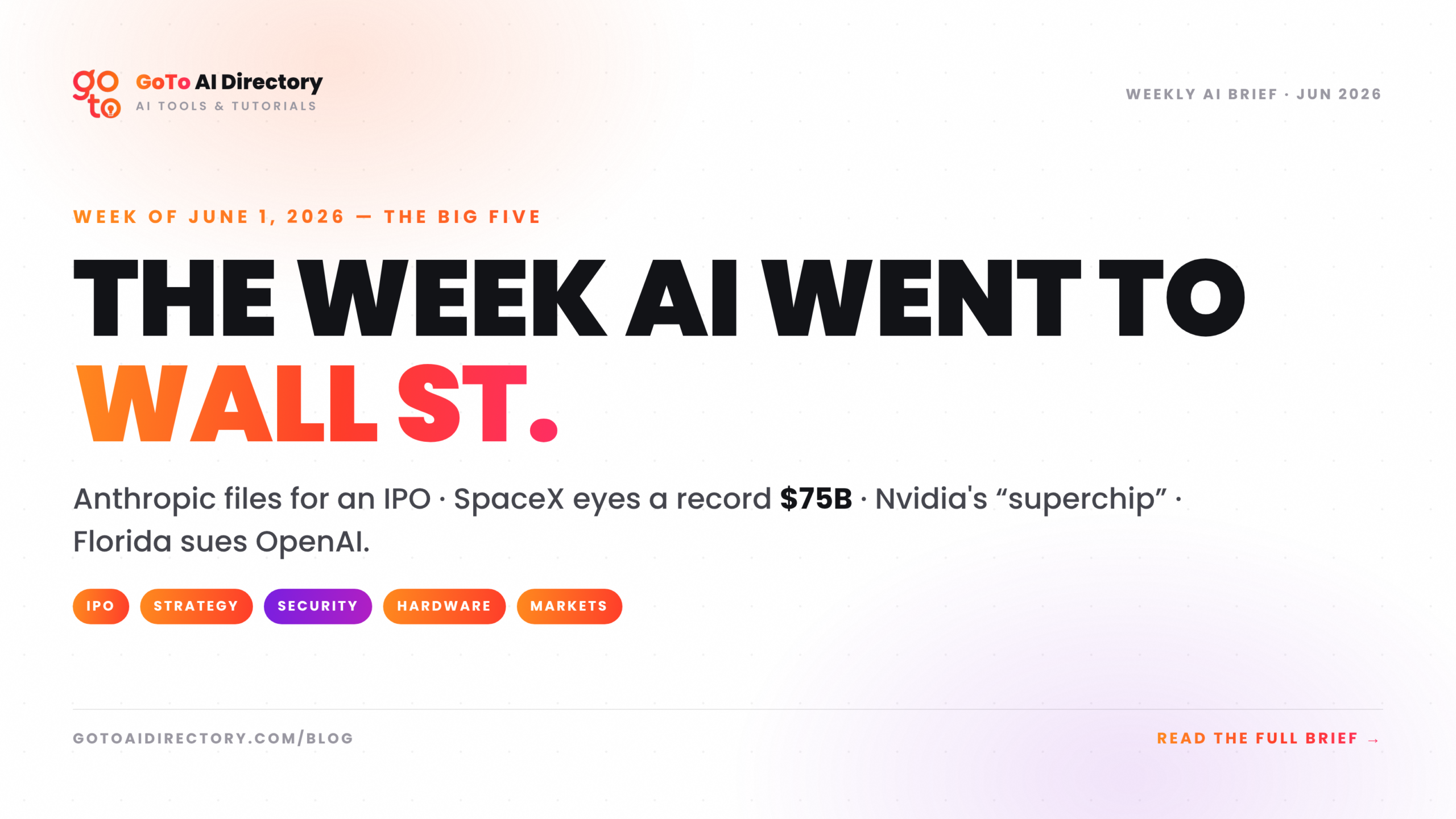
Your fast briefing on the tech stories that matter to business and IT leaders this week — public-market debuts, a shift in enterprise AI strategy, fresh security risks and the regulation catching up to it all. Here’s your Latest AI news for June 2026.
The first week of June 2026 packed in a remarkable run of milestones. Anthropic took its first formal step toward Wall Street, SpaceX teased what could be the biggest stock-market debut in history, and Nvidia tried to move serious AI horsepower off the cloud and onto your laptop. At the same time, the mood around enterprise AI cooled, a chatbot breach exposed high-profile accounts, and regulators in Washington and Florida sharpened their focus on the industry.
Here’s everything you need to know from the week beginning June 1, plus the latest IPO listings and executive appointments.
Anthropic files to go public
Anthropic confirmed on June 1 that it has submitted a confidential draft registration with the U.S. Securities and Exchange Commission, clearing the way for a future initial public offering. The company framed the filing as keeping its options open: any listing would follow the SEC’s review and hinge on market conditions.
The significance is hard to overstate. If the deal goes through, Anthropic could become one of the first major frontier AI labs to trade on public markets — potentially reaching investors before rival OpenAI does. Getting there first would hand the company a financing edge as the cost of training next-generation models keeps climbing, and it would likely turn up the competitive heat across the entire AI sector.
For technology leaders, the takeaway runs deeper than another headline IPO. Anthropic stepping toward the public markets is a marker of the industry growing up — moving from a phase of vendor experimentation into one defined by the scrutiny, disclosure and accountability that come with being a publicly traded company.
Amazon pumps the brakes on “AI for AI’s sake”
For several years the corporate playbook has been simple: push employees to weave AI into as many tasks as possible and treat heavy usage as proof of progress. This week Amazon signaled a notable change of heart. According to reports, senior leaders have begun telling staff to stop adopting AI tools simply to be seen using them.
The clearest sign of the pivot was Amazon retiring an internal leaderboard that ranked employees by how much AI they used. Amazon isn’t alone — Meta reportedly pulled a similar internal scoreboard, a move away from the “tokenmaxxing” mentality of maximizing AI consumption for its own sake.
The lesson for executives is that enterprise AI is entering a new chapter. Instead of rewarding raw activity and rolling AI out indiscriminately, organizations are starting to measure it against concrete business results. The conversation inside companies is shifting away from adoption metrics and toward operational value — does the tool actually move the needle?
Hackers trick Meta’s AI chatbot into leaking passwords
A serious security episode is raising fresh doubts about handing customer-support duties to AI. Attackers reportedly manipulated Meta’s AI-powered support assistant into surrendering the passwords for several high-profile Instagram accounts, including Barack Obama’s White House account, beauty retailer Sephora and the senior enlisted leader of the U.S. Space Force.
Meta says it has patched the flaw and is locking down the affected accounts. Investigators believe the attackers exploited gaps in how the AI made decisions, talking it into completing actions that should have been gated behind stricter identity verification.
The incident is a textbook cautionary tale: giving an AI agent access to sensitive accounts before strong guardrails exist invites trouble. Expect it to fuel louder demands for human oversight, tighter authentication and far more rigorous testing before AI systems are trusted with high-stakes functions.
Nvidia unveils the RTX Spark “superchip” for AI PCs
Nvidia’s newest play in the AI race is RTX Spark, an architecture built to shift AI workloads from the data center to the personal computer. Revealed at Computex 2026 and quickly nicknamed the “superchip,” it fuses a high-performance CPU, a GPU, dedicated AI accelerators and unified memory into a single package — enough muscle to run advanced AI models directly on a laptop or desktop.
Major PC makers including Dell, HP, Lenovo, Asus and Microsoft are expected to build machines around the platform, which Nvidia is aiming at creators, AI developers and gamers. The launch underscores the company’s ambition to push beyond its data-center stronghold and stake a claim in everyday client computing — where on-device AI promises lower latency, better privacy and less dependence on the cloud.
Florida sues OpenAI and Sam Altman
In a first-of-its-kind action, Florida Attorney General James Uthmeier filed a state-led lawsuit against OpenAI and chief executive Sam Altman, tying the company to a series of violent incidents. The complaint argues that OpenAI understated the safety risks of its technology, including potential harm to children and other vulnerable users, and that those alleged misrepresentations contributed to real-world damage.
The suit marks a meaningful escalation in regulatory pressure on generative AI. With its focus on consumer protection, Florida’s filing reflects mounting public anxiety about AI-generated misinformation and the broader social impact of these tools — and it lands just after a papal encyclical that warned about the risks of unchecked AI.
Trump signs an AI executive order
On June 2, President Trump signed an executive order designed to give the government access to advanced AI models in the name of reducing cybersecurity risk. The order sets up a framework for reviewing AI systems before they ship and deepens federal involvement in the technology race.
The administration is pitching it as a lighter-touch alternative to heavier-handed regulation while still addressing national-security concerns. An earlier draft reportedly floated a 90-day government review window for frontier models ahead of public release. Either way, the order signals a recalibration: rather than leading with regulation, Washington is trying to balance competitiveness, security and innovation.
SpaceX targets the largest IPO in history
SpaceX capped the week with a blockbuster. The company outlined plans for an IPO that could raise as much as $75 billion and value it at roughly $1.77 trillion — which would make it the biggest public offering the markets have ever seen.
The plan calls for selling more than 555 million shares at $135 apiece, eclipsing the record Saudi Aramco set back in 2019. Even at that scale, Elon Musk is set to retain control of about half of all shares and roughly 82% of the voting power once the offering closes. The sheer size of the deal is one more signal that investors remain willing to make enormous bets on the companies building the next wave of critical technology platforms.
Key takeaways for tech and business leaders
- AI is going public — literally. Anthropic’s filing and SpaceX’s record-setting plan show capital markets and frontier technology converging. Public scrutiny, disclosure and quarterly accountability are coming to the AI sector.
- Usage is out; outcomes are in. Amazon and Meta retiring their AI leaderboards reflects a maturing strategy. Tie AI investments to measurable results, not activity for its own sake.
- Agentic AI needs guardrails first. The Meta chatbot breach is a warning: don’t connect AI agents to sensitive systems before identity checks, human oversight and adversarial testing are in place.
- On-device AI is the next battleground. Nvidia’s RTX Spark pushes AI compute toward the PC, with implications for latency, data privacy and your endpoint strategy.
- Regulation is accelerating. Between Florida’s lawsuit and a new federal executive order, governance and compliance now belong on every AI roadmap.
Executive moves this week
- Jorge Gomez was named CEO of state-owned mining giant Codelco on June 3, with his tenure beginning July 13.
- Eric Litz joined surveillance and financial-risk firm Eventus as chief technology officer, arriving from a leadership role at Copperhead Technology Group.
- Raj Jegannathan was appointed CTO of AI infrastructure provider ChronoScale on June 4, where he will steer the company’s global AI compute and GPU platform strategy.
IPO watch: recent and upcoming U.S. listings
The U.S. IPO calendar remains a useful barometer of tech-market sentiment. Here’s a snapshot of recent and expected listings from the week, based on Nasdaq IPO calendar data:
| Company | Type / sector | Trading day | IPO price |
|---|---|---|---|
| Applied Aerospace & Defense, Inc. | Aircraft, satellites & defense systems | June 3 | $20/share |
| Keystone Acquisition Corp. | Blank-check company | June 3 | $10/share |
| AmperCap Acquisition Co. | Blank-check company | June 3 | $10/share |
| Research Alliance Corp III | SPAC | June 3 | $10/share |
| Liftoff Mobile, Inc. | AI-powered mobile-app growth | June 4 (expected) | $23/share |
| Sunshine Silver Mining & Refining Co. | Mining | June 4 (expected) | $13.50/share |
| Long Table Growth Corp. | SPAC | June 4 (expected) | $10/share |
| InterPrivate Investment Partners V, Inc. | SPAC | June 4 (expected) | $10/share |
| Quantinuum Inc. | Quantum computing | June 4 (expected) | $60/share |
| Safepoint Holdings, Inc. | Property & casualty insurance | June 4 (expected) | $15–17/share |
| INNIO Group Holding B.V. | Energy solutions | June 4 (expected) | $27/share |
| WhiteHawk Income Corp. | Oil & gas royalties | June 5 (expected) | $25–27/share |
| Innovative Digital Investors Acquisition Corp. | Blank-check company | June 5 (expected) | $10/share |
Frequently asked questions
Did Anthropic actually IPO this week? Not yet. Anthropic filed a confidential draft registration with the SEC on June 1, which is the first step toward a possible IPO. An actual listing would come only after the SEC’s review and would depend on market conditions.
How big could the SpaceX IPO be? SpaceX outlined plans to raise up to $75 billion, which would value the company near $1.77 trillion and rank as the largest IPO on record, surpassing Saudi Aramco’s 2019 offering.
What is Nvidia’s RTX Spark “superchip”? RTX Spark is a new Nvidia architecture revealed at Computex 2026 that combines a CPU, GPU, AI accelerators and unified memory in one package so advanced AI models can run locally on a PC or laptop rather than in the cloud.
Why is Florida suing OpenAI? Florida’s attorney general filed the first state-led lawsuit against OpenAI and CEO Sam Altman, alleging the company downplayed safety risks — including potential harms to children — and linking those alleged misrepresentations to violent incidents.
Why did Amazon tell staff to stop using AI? Amazon reportedly asked employees to stop adopting AI “just for the sake of it” and shut down an internal leaderboard tracking AI usage, signaling a shift from rewarding activity toward measuring real business outcomes.