
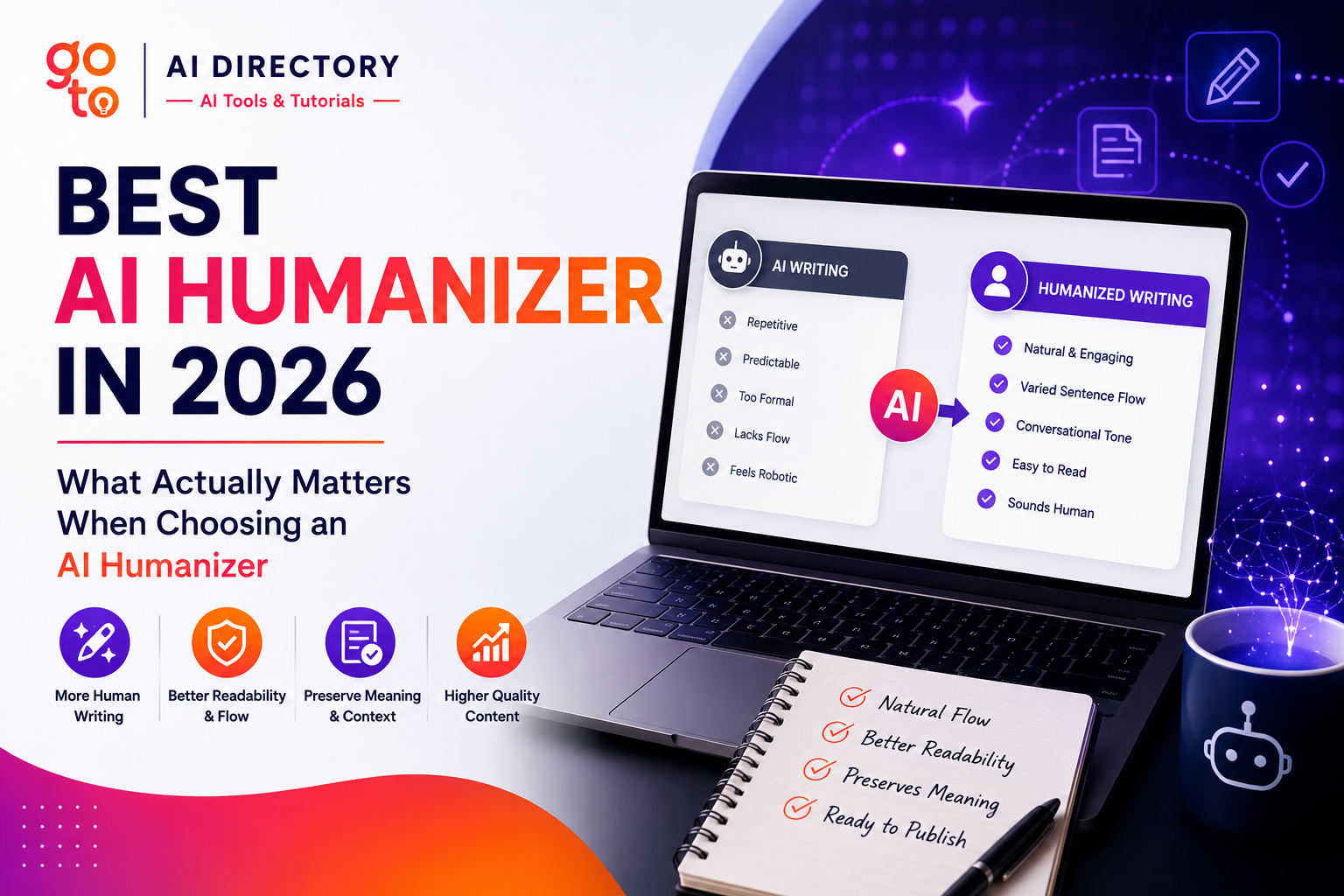
Best AI Humanizer in 2026: What Actually Matters When Choosing an AI Humanizer
AI writing has become part of my daily workflow. Whether I’m drafting blog posts, brainstorming ideas, or summarizing research, tools like ChatGPT and Claude save an incredible amount of time. But there’s one thing I’ve noticed after publishing hundreds of articles.
The first draft is rarely the final draft. Sometimes the writing feels repetitive. Sometimes every paragraph starts the same way. Other times the sentences are technically correct but don’t sound like something a real person would naturally write. That doesn’t mean AI is bad at writing. It simply means AI is very good at producing predictable writing. That’s exactly why AI humanizers have become so popular.
Over the past few months, I’ve experimented with different AI humanizers while editing content for blogs, tutorials, and comparison articles. I also reviewed independent benchmark testing to understand how these tools actually perform instead of relying on marketing claims. One thing became obvious very quickly. The best AI humanizer isn’t necessarily the one that claims the highest AI detector score. The best one is the one that makes your writing sound natural without changing what you’re trying to say.
In this guide, we’ll look at how AI humanizers work, what makes a good one, common mistakes people make, and the lessons I learned from comparing today’s leading tools.
What Is an AI Humanizer?
An AI humanizer is software that rewrites AI-generated text to improve its readability and make it sound more natural. Instead of generating completely new content, an AI humanizer edits existing text by adjusting sentence structure, varying word choice, improving flow, and reducing repetitive patterns that are common in AI-generated writing.
People often use an AI humanizer after creating content with tools such as ChatGPT, Claude, Gemini, or other AI writing assistants. The goal isn’t simply to change words. The goal is to make the writing feel as though it has been edited by a person.
Why Are AI Humanizers Becoming More Popular?
The rise of generative AI has made writing faster than ever. The challenge is that many AI models have recognizable writing habits. You may have noticed things like:
- Similar sentence lengths throughout an article
- Repeated transition words
- Generic introductions
- Overly polished wording
- Predictable paragraph structure
None of these necessarily make the content incorrect. But together, they can make articles feel less engaging. An AI humanizer helps introduce more natural variation while preserving the original meaning. For bloggers, marketers, freelancers, students, and businesses, this can reduce editing time and improve the overall reading experience.
What Makes the Best AI Humanizer?
After comparing different tools and reviewing independent benchmark results, I found that the strongest AI humanizers consistently perform well in a few key areas.
| Feature | High-Quality AI Humanizer | Low-Quality AI Humanizer |
|---|---|---|
| Preserves original meaning | ✅ Yes | ❌ Changes the message |
| Natural sentence flow | ✅ Smooth and varied | ❌ Repetitive or awkward |
| Readability | ✅ Easy to follow | ❌ Difficult to read |
| Grammar | ✅ Accurate | ❌ Introduces mistakes |
| Editing required afterward | ✅ Minimal | ❌ Significant |
| Best suited for | Publishing and editing | Rough rewrites only |
Notice what’s not included in this table. AI detector scores. That’s intentional. Although many people search for an AI humanizer based on detector performance, detector scores alone don’t tell you whether the writing is actually good.
My Biggest Takeaway After Reading the Latest Benchmark
One of the most interesting resources I reviewed while researching this article was the July 2026 HumanizerBench, an independent benchmark comparing 13 AI humanizer tools across five commercial AI detectors. On top of the list was WriteHuman.
Instead of focusing on a single detector, the benchmark evaluated several important factors, including:
- Detector performance
- Readability
- Meaning preservation
- Rewrite consistency
- Text expansion
- Overall writing quality
What surprised me most was that the tool with the highest detector pass rate did not finish first overall. That initially seemed strange. After reading the methodology, it made much more sense.
Some tools achieved higher detector scores by significantly expanding the original text. While this sometimes improved detector results, it also made the rewritten content longer than necessary and reduced the overall quality score because additional wording had been introduced. That matches something I’ve experienced while editing AI-generated articles.
Longer writing isn’t automatically better writing. If a 900-word article suddenly becomes 1,400 words without adding meaningful information, you’re creating more editing work instead of less. For me, that’s one of the easiest ways to judge an AI humanizer. If I have to spend another fifteen minutes removing unnecessary sentences, it hasn’t really saved me any time.
What I Personally Look for in an AI Humanizer
Everyone has different priorities. Some people want the highest AI detector score. Others care more about readability. After working with AI-generated content almost every day, I’ve found myself looking for something much simpler.
I ask four questions.
1. Does it preserve the original meaning?
A rewrite should communicate the same ideas. Changing important details simply to sound different often creates more problems than it solves.
2. Does it actually sound natural?
Some AI humanizers simply replace words with synonyms. Good editing goes much further than that. The strongest tools restructure sentences, vary rhythm, and improve flow without making the content sound forced.
3. Does the tone stay consistent?
I’ve tested tools that produced an excellent first paragraph before gradually becoming repetitive again. Consistency matters just as much as the quality of individual sentences.
4. How much editing do I still need to do?
This is probably the biggest test. If I can publish after making only a few small edits, the tool has done its job. If I spend another twenty minutes rewriting paragraphs, the software hasn’t saved much time.
When Should You Use an AI Humanizer?
One thing I’ve realized after working with AI-generated content is that an AI humanizer isn’t necessary for every piece of writing. For quick brainstorming or personal notes, the original AI output is often good enough. But if you’re publishing content that represents your business or personal brand, taking a few extra minutes to improve readability can make a noticeable difference.
Here’s how I think about it.
| Content Type | Should You Use an AI Humanizer? | Why |
|---|---|---|
| Blog posts | ✅ Yes | Improves readability and creates a more natural writing style. |
| Marketing copy | ✅ Yes | Makes promotional content sound more conversational. |
| Emails | ✅ Yes | Reduces robotic wording and improves tone. |
| Social media posts | Usually | Helps create shorter, more engaging content. |
| Academic writing | Sometimes | Useful for readability, but accuracy should always come first. |
| Personal notes | No | Humanizing usually isn’t necessary. |
For me, blog articles benefit the most. Readers spend several minutes with the content, so small improvements in flow and sentence variety can have a big impact on the overall experience.
Common Mistakes People Make with AI Humanizers
After experimenting with different tools, I’ve noticed that many people expect an AI humanizer to solve every problem automatically. In reality, it’s best viewed as an editing assistant rather than a one-click publishing tool. Here are a few mistakes I see regularly.
1. Focusing Only on AI Detector Scores
This is probably the biggest misconception. Many users search for the best AI humanizer based entirely on detector results. While detector scores can be interesting, they don’t tell you whether readers will actually enjoy your content. A paragraph can score well on an AI detector and still feel repetitive or awkward. For me, readability always comes first.
2. Publishing Without Reading the Rewrite
Even excellent AI tools occasionally introduce awkward phrases or change the emphasis of a sentence. I always read the final version before publishing. It usually takes less than five minutes, but it’s often enough to catch small issues that automated tools miss.
3. Over-Humanizing the Content
Some tools allow aggressive rewriting modes. In my experience, those settings sometimes create longer paragraphs, unnecessary wording, or even alter the meaning of the original text. A lighter edit often produces better results.
4. Forgetting Your Own Voice
An AI humanizer should improve your writing, not replace your personality. Whenever possible, I add something personal before publishing. That could be:
- A lesson I learned
- A real example
- A personal observation
- A practical tip
Those additions usually make a much bigger difference than another automated rewrite.
My AI Editing Workflow
People often ask whether I write articles entirely with AI. The answer is no. AI helps me create the first draft faster, but every article still goes through several editing steps before it’s published. My workflow usually looks something like this:
Step 1: Create the first draft
I use AI to organize ideas and produce a solid starting point.
Step 2: Fact-check important information
If an article includes statistics, product features, or technical details, I verify them using official documentation or trusted sources.
Step 3: Improve readability
This is where an AI humanizer can help.
I look for repetitive wording, awkward transitions, and overly formal language.
Step 4: Add personal insights
This is probably the most important step.
I ask myself:
“Does this sound like something I’d actually say?”
If the answer is no, I rewrite it.
Step 5: Final manual review
Before publishing, I read the article from beginning to end.
Sometimes I even read difficult sections aloud.
If a sentence feels unnatural when spoken, it usually needs another edit.
My Editing Checklist
Whenever I’m reviewing AI-generated content, I usually check for the following:
✅ Does every paragraph answer the reader’s question?
✅ Are there too many similar sentence openings?
✅ Can any paragraph be shortened?
✅ Have I added a real example or personal observation?
✅ Does the article still sound like me?
It isn’t a complicated process, but these small edits often make the biggest difference.
Do AI Humanizers Replace Human Editing?
In my opinion, not yet. AI humanizers have improved significantly over the past couple of years, but I still think they’re most valuable as editing assistants rather than complete replacements for human review. They can improve sentence flow, reduce repetition, and make content easier to read. What they can’t always do is understand context the way a human editor can.
For example, they may not know:
- Which example is most relevant to your audience
- When a sentence feels too formal
- Whether a joke lands naturally
- If a paragraph supports your overall argument
Those are still decisions that require human judgment.
That’s why I see AI humanizers as time-saving tools rather than “publish” buttons.
Frequently Asked Questions
What is the best AI humanizer?
The best AI humanizer is the one that preserves your original meaning while making the writing sound more natural. Instead of focusing only on AI detector scores, compare tools based on readability, consistency, editing effort, and writing quality.
Do AI humanizers really work?
Yes. A good AI humanizer can improve sentence flow, reduce repetitive phrasing, and make AI-generated content feel more conversational. The results vary between tools, so it’s worth testing a few to see which matches your writing style.
Can an AI humanizer bypass AI detectors?
Some AI humanizers may perform better than others against specific detectors, but no tool can guarantee consistent results across every platform. AI detection systems continue to evolve, so writing quality should remain the primary focus.
Should bloggers use an AI humanizer?
If you regularly publish AI-assisted content, an AI humanizer can be a helpful editing step. It can reduce repetitive phrasing, improve readability, and make articles feel more engaging without changing the core message.
Is using an AI humanizer enough before publishing?
Not usually. Even after using an AI humanizer, it’s a good idea to review the content manually, verify facts, and add your own examples or insights before publishing.
Final Thoughts
The more I work with AI-generated content, the more I believe that great writing comes from good editing, not from choosing a single “perfect” AI tool. An AI humanizer can improve sentence flow, reduce repetitive phrasing, and make your content easier to read. But it works best when it’s part of a broader editing process rather than the final step. If there’s one lesson I took away from testing different tools and reviewing independent benchmark data, it’s this:
Don’t judge an AI humanizer by its marketing claims or detector scores alone.
Instead, ask a simpler question:
“Does this make my writing more enjoyable for a real person to read?”
If the answer is yes, then the tool is doing its job. As AI writing continues to improve, I think the most valuable humanizers won’t be the ones that promise to “beat” AI detectors. They’ll be the ones that help writers communicate more clearly, preserve their own voice, and spend less time on repetitive editing. If you’re exploring more AI writing tools, productivity software, or content creation platforms, you’ll also find detailed comparisons and practical guides on GoToAIDirectory to help you choose the right tools based on real-world use cases rather than marketing promises.