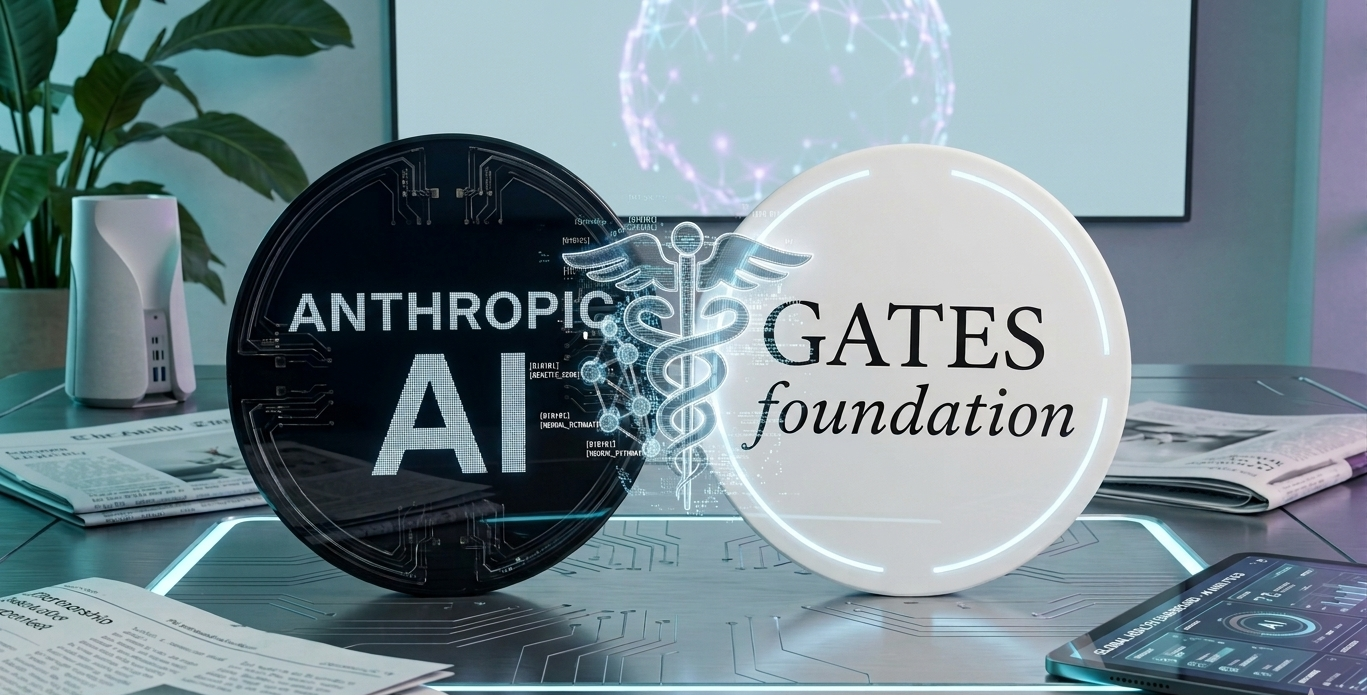
When Anthropic and the Gates Foundation announced a $200 million commitment on May 14, 2026, the message was clear: AI’s next frontier is not a product feature or a benchmark — it is reaching the four billion people who currently have no access to essential health services.
The four-year partnership combines grant funding, Claude usage credits, and technical support across four focus areas: global health, life sciences, K-12 education, and economic mobility. The programs will run in the United States and internationally, with a particular emphasis on sub-Saharan Africa, India, and other low- and middle-income countries.
What the Partnership Actually Covers
The $200 million commitment is split between Anthropic and the Gates Foundation. Anthropic is contributing technical support and Claude API credits, while the Gates Foundation is contributing grant funding, program design expertise, and its global implementation network.
Global Health and Vaccines
The largest portion of the partnership is focused on healthcare in low- and middle-income countries, where approximately 4.6 billion people lack access to essential health services.
Specific programs include:
- Accelerating vaccine candidate screening for diseases including polio and HPV, using Claude to help scientists identify patterns across systematic reviews and large datasets before moving to pre-clinical development
- Working with the Institute for Disease Modeling — a Gates Foundation research group — to improve disease forecasts for illnesses like malaria and tuberculosis, helping governments decide where to deploy treatment faster
- Building AI connectors that give Claude direct access to health platforms and research tools used by frontline workers and health ministries
- Developing benchmarks and evaluation frameworks to measure how AI systems perform on healthcare-specific tasks, with results released publicly
K-12 Education
The education strand focuses on deploying Claude-powered tools for students and teachers across the United States, sub-Saharan Africa, and India.
Programs include:
- AI tutoring systems and literacy and numeracy tools for K-12 students
- College advising and career guidance platforms
- Curriculum design support for teachers
- Knowledge graphs to support teachers in sub-Saharan Africa and India, with data to be publicly released to improve AI models industry-wide
A key priority is language accessibility, particularly in African languages where current AI systems have historically performed poorly. The partnership plans to fund data collection and labeling in these languages and release the resulting datasets publicly.
Economic Mobility
Beyond health and education, the partnership will support programs designed to improve economic access. This includes AI tools for smallholder farmers, career guidance platforms for workers transitioning between jobs, and skill-tracking tools for workforce development.
Why This Is Different from Standard Corporate Philanthropy
The Anthropic-Gates deal is structured differently from a standard donation or grant.
Anthropic’s contribution is not purely financial — it includes engineering support from its Beneficial Deployments team, which provides Claude credits and technical resources to partners in the four priority areas. The partnership also commits to building public goods: benchmarks, datasets, evaluation frameworks, and knowledge graphs that will be freely available to researchers and developers worldwide, not locked inside proprietary systems.
The framing from both organizations is that these are areas where markets alone will not deliver results. Commercial AI development follows revenue — it goes where paying customers are. Global health in sub-Saharan Africa, literacy programs in rural India, and disease forecasting for neglected tropical diseases do not generate the returns that attract private investment. This partnership is designed to fill that gap directly.
The Broader AI-for-Good Moment in 2026
The Anthropic-Gates partnership is part of a broader pattern forming in 2026.
Earlier in the year, Bill Gates partnered with OpenAI on a separate $50 million initiative called Horizon1000, aimed at improving operations in 1,000 primary healthcare clinics in Africa. Moderna is working with OpenAI to accelerate drug development. The Mayo Clinic has deployed an AI model called REDMOD that detects pancreatic cancer on routine CT scans up to three years before conventional diagnosis.
The convergence of large AI models with global health infrastructure is accelerating faster than most policy frameworks can track.
What This Means for Anthropic
For Anthropic, the Gates partnership serves both mission and market.
On the mission side, it demonstrates that Claude can operate reliably in high-stakes, resource-constrained environments — a different challenge than enterprise productivity tools. On the market side, it builds credibility with governments, health ministries, and international institutions that represent an enormous long-term procurement opportunity.
It also arrives at a moment when Anthropic is reportedly preparing for its own IPO, targeting an October 2026 listing at a valuation above $900 billion. Demonstrating social impact at scale — particularly in healthcare — is not incidental to that story. It is part of it.
Frequently Asked Questions
What is the Anthropic Gates Foundation partnership? A four-year, $200 million commitment announced in May 2026 to apply AI — specifically Anthropic’s Claude — to global health, vaccine development, K-12 education, and economic mobility, primarily in underserved regions.
How is the $200 million split? The funding is split evenly. Anthropic is contributing technical support and Claude API credits; the Gates Foundation is contributing grant funding, program design, and implementation expertise.
Which diseases is the partnership targeting? Initial health programs focus on polio, HPV, eclampsia, malaria, and tuberculosis — diseases with high burden in low-income countries that receive limited commercial research investment.
Will the tools and datasets be publicly available? Yes. The partnership explicitly commits to releasing benchmarks, datasets, evaluation frameworks, and knowledge graphs publicly so the broader AI and research community can benefit.
How does this differ from the OpenAI-Gates Horizon1000 project? The Horizon1000 project, announced earlier in 2026, focused specifically on improving operations in 1,000 primary healthcare clinics in Africa with a $50 million budget. The Anthropic-Gates deal is broader in scope, covering vaccines, disease forecasting, education, and economic mobility across multiple regions.
Key Takeaways
- Anthropic and the Gates Foundation committed $200 million over four years, announced May 14, 2026.
- The partnership covers global health, life sciences, K-12 education, and economic mobility.
- Approximately 4.6 billion people in low- and middle-income countries lack essential health services — the primary target population.
- Claude will be used for vaccine candidate screening, disease forecasting, student tutoring, and career guidance tools.
- All benchmarks, datasets, and knowledge graphs produced will be released publicly.
- The deal reflects a growing pattern of major AI companies directing resources toward global health challenges outside commercial market reach.
Last updated: May 2026. Program details are based on announcements from Anthropic and the Bill & Melinda Gates Foundation.