Why these three terms matter in 2026
Search has fragmented into three distinct surfaces, and each one requires different optimization signals. Optimizing only for traditional Google search now covers less than half of where users actually look for information.
The data behind the shift
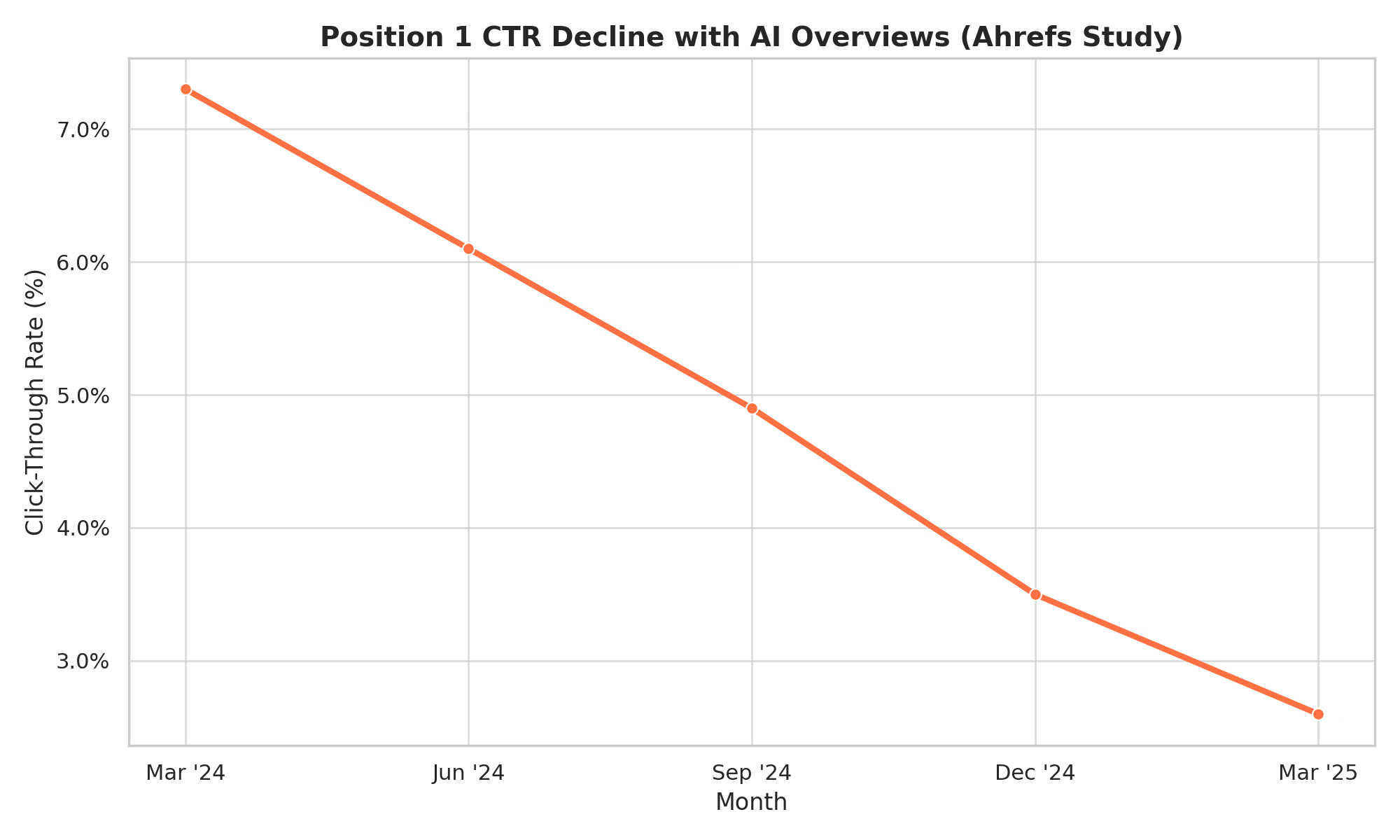
- According to Ahrefs research cited by Jasper AI, Google AI Overviews have reduced click-through rates for top-ranking content by 58%.
- Over 60% of Google searches now end without a click to a third-party site.
- Up to 47% of Google searches feature AI-generated overviews as of 2025.
- ChatGPT processes approximately 2.5 billion prompts daily, with roughly 65% qualifying as search queries.
- ChatGPT has a 96% lower click-through rate than Google because users get answers without clicking.
The result: brands that rely exclusively on traditional SEO are losing visibility even when their rankings remain stable. AEO and GEO have emerged to address the two new search surfaces, namely answer engines and AI-generated responses.
What is SEO?
Search Engine Optimization (SEO) is the practice of improving a website’s visibility in traditional search engine results pages. SEO has existed since the late 1990s and is the most mature of the three disciplines.
Core SEO signals
SEO optimization focuses on:
- Backlinks. The number and quality of sites linking to a page.
- Keyword relevance. Alignment between content and search queries.
- On-page elements. Title tags, meta descriptions, headings, URL structure.
- Technical SEO. Site speed, crawlability, mobile responsiveness, indexability.
- Content quality. Depth, originality, and topical coverage.
- User experience. Bounce rate, dwell time, Core Web Vitals.
SEO’s goal
The goal of SEO is to rank as high as possible on search engine results pages, driving organic clicks to your website. A user has to click your result for SEO to deliver value.
Why SEO still matters in 2026
Traditional SEO has not been replaced. It has been supplemented. Google AI Overviews and other AI features heavily favor pages already ranking in the top 10 organic results. Strong SEO remains the foundation that makes AEO and GEO possible.
What is AEO?
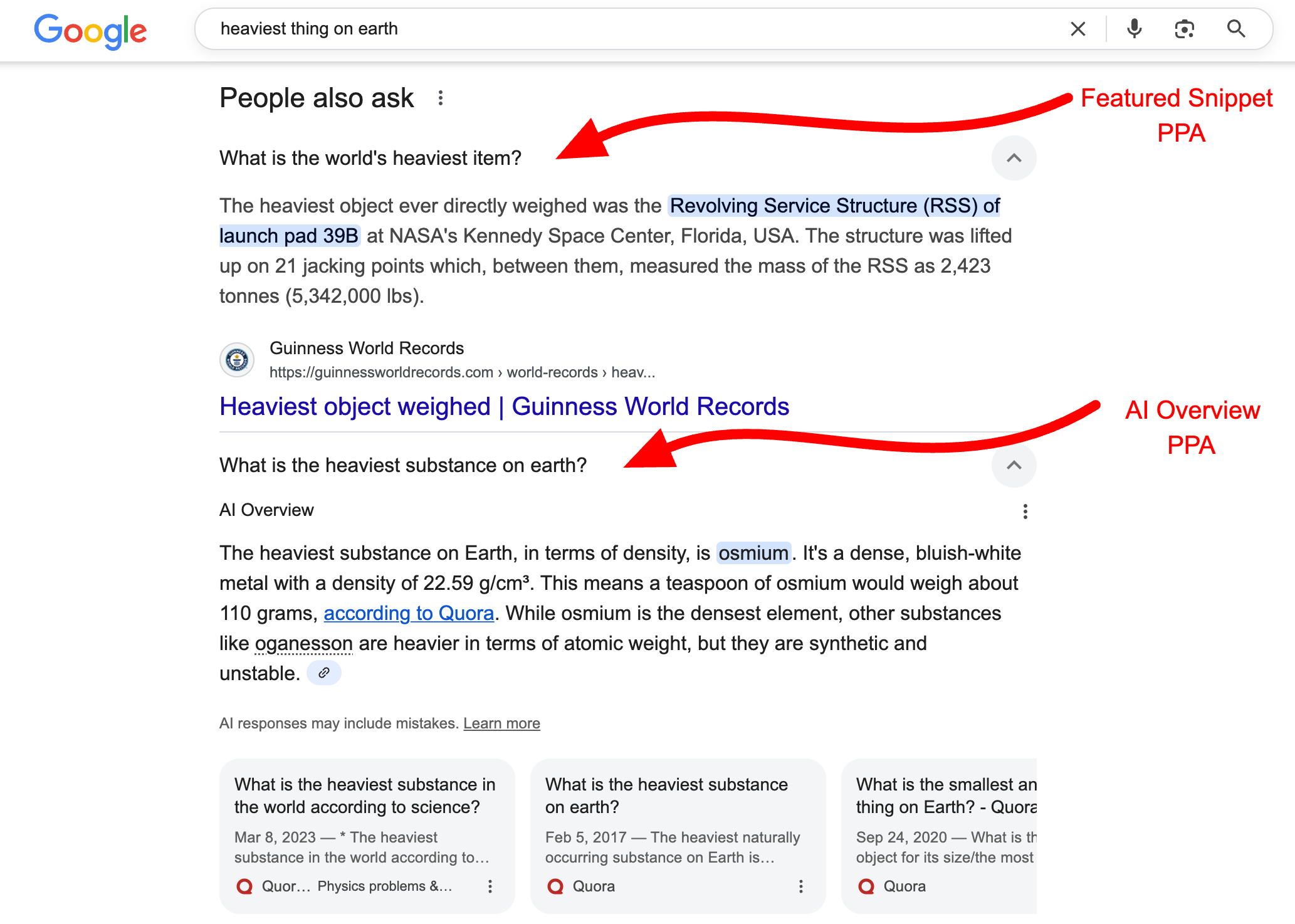
Answer Engine Optimization (AEO) is the practice of optimizing content to appear as a direct answer in featured snippets, voice search results, and AI-generated answer boxes. AEO emerged as featured snippets and voice assistants like Alexa, Siri, and Google Assistant became major information sources.
Core AEO signals
AEO optimization focuses on:
- Direct-answer formatting. Concise, scannable responses to specific questions.
- Question-format headings. H2s that mirror common search queries.
- Structured data and schema markup. Particularly FAQ, How-To, and Q&A schemas.
- Featured snippet optimization. Paragraph, list, and table formats.
- Voice search readiness. Natural language phrasing and conversational structure.
- Quick definitions. Clear, sourceable answers in the first one or two sentences of a section.
AEO’s goal
The goal of AEO is to become the source that answer engines pull from. This includes featured snippets in Google, voice assistant responses, and traditional AI answer boxes. A user doesn’t always need to click for AEO to deliver value because brand visibility happens through the answer itself.
Where AEO content appears
- Google Featured Snippets (Position Zero)
- Google AI Overviews (often called AIO)
- Voice assistant responses (Alexa, Siri, Google Assistant)
- Bing AI answer boxes
- “People Also Ask” expandable answers
What is GEO?
Generative Engine Optimization (GEO) is the practice of structuring content so it gets cited inside answers generated by AI systems like ChatGPT, Gemini, Claude, Grok, Perplexity, and Microsoft Copilot. GEO is the newest of the three disciplines, named in May 2025 by Andreessen Horowitz in their AI thesis, though related practices preceded the term.
According to Wikipedia, GEO “influences the way large language models, such as ChatGPT, Google Gemini, Claude, Perplexity AI and Copilot retrieve, summarize, and present information in response to user queries.”
Core GEO signals
GEO optimization focuses on:
- Entity clarity. Clearly defined people, places, products, and concepts.
- Semantic depth. Comprehensive coverage of related concepts and relationships.
- Structured data. Schema markup that AI systems parse for context.
- Topical authority. Clusters of related content demonstrating expertise.
- Machine-readable formatting. Clear hierarchy and direct claims.
- LLMs.txt files. An emerging convention telling AI models which content to prioritize.
- Citation-worthy claims. Fact-dense, verifiable statements with source attribution.
GEO’s goal
The goal of GEO is to become a cited source inside synthesized AI answers. Unlike SEO (where you rank a page) or AEO (where you provide a direct answer), GEO content gets compressed into a multi-source AI response and your domain appears as a citation.
Where GEO content appears
- ChatGPT responses (including ChatGPT Search citations)
- Google Gemini synthesized answers
- Claude responses
- Grok answers
- Perplexity source citations
- Microsoft Copilot responses
- Google AI Overviews (overlapping with AEO)
Are AEO and GEO the same thing?
AEO and GEO overlap significantly, and some practitioners use the terms interchangeably. The most useful distinction is one of scope: AEO is broader, GEO is more specific to generative AI systems.
How experts define the distinction
According to Contentful’s analysis, GEO is “also known as answer engine optimization (AEO).” Many practitioners treat them as the same discipline.
According to Stackmatix’s 2026 guide, AEO is the broader category covering all answer engines (including featured snippets, voice assistants, and AI answer boxes), while GEO is specifically about generative AI systems like ChatGPT and Gemini.
According to the Wikipedia entry on GEO, “No consensus definition distinguishing these terms” exists across practitioners.
The practical takeaway
| Term | Scope |
|---|---|
| AEO | All answer engines: featured snippets, voice search, AI Overviews, AI chatbots |
| GEO | Specifically generative AI systems: ChatGPT, Gemini, Claude, Perplexity |
| LLMO | Technical subset of GEO focused on how LLMs retrieve and cite content |
| AIO | Specifically Google’s AI Overviews implementation |
For most marketers, AEO and GEO can be treated as complementary strategies that overlap by about 70%. If you optimize for one, you’re partially optimizing for the other.
Side-by-side comparison: SEO vs AEO vs GEO
| Dimension | SEO | AEO | GEO |
|---|---|---|---|
| Full name | Search Engine Optimization | Answer Engine Optimization | Generative Engine Optimization |
| Origin | Late 1990s | Mid-2010s (with voice assistants) | 2024 to 2025 (named formally in May 2025) |
| Primary platforms | Google, Bing | Featured snippets, voice assistants, AI answer boxes | ChatGPT, Gemini, Claude, Perplexity, Grok |
| Goal | Rank high on results pages | Become the source of direct answers | Get cited inside AI-generated responses |
| Success metric | Organic traffic, rankings | Featured snippet placements, voice search appearances | Brand mentions and citations in AI answers |
| Key signals | Backlinks, on-page, technical | Schema, direct answers, FAQ format | Entity clarity, semantic depth, structured data |
| Click required? | Yes, users click your result | Sometimes, answer may appear inline | Often no, brand visibility through citation |
| Maturity in 2026 | Mature | Established | Emerging |
| Tools available | Many (Ahrefs, Semrush, Surfer) | Growing (FAQ-focused tools) | Limited but expanding (AISEO, Frase, Profound, Rankscale) |
Which should you optimize for first?
Optimize for SEO first because it remains the foundation for AEO and GEO. Then layer in AEO and GEO simultaneously, since they share most of the same signals.
The recommended sequence
Stage 1: Build SEO foundations (weeks 1 to 8)
Without strong SEO, AEO and GEO have nothing to build on. Google AI Overviews heavily favor pages already ranking in the top 10, and AI systems prefer citing authoritative domains.
Focus on:
- Technical SEO (site speed, crawlability, mobile)
- Keyword research and topic clusters
- High-quality, original content
- On-page optimization
- Internal linking architecture
Stage 2: Add AEO formatting (weeks 4 to 12, parallel to Stage 1)
AEO improvements are formatting-driven and can begin immediately on new content.
Focus on:
- Question-format headings (H2s)
- Concise direct answers at the top of each section
- FAQ sections with schema markup
- “Quick Answer” boxes at the top of long articles
- How-To and FAQ schema implementation
- Bulleted lists and tables for scannable answers
Stage 3: Layer GEO signals (weeks 8 to 16, parallel to Stage 2)
GEO requires the AEO foundation plus additional structural signals.
Focus on:
- Entity clarity (clearly define people, products, concepts)
- Topical authority through content clusters
- Comprehensive coverage of related concepts
- Citation-worthy fact density
- Author bylines and expertise signals (E-E-A-T)
- LLMs.txt file creation
- Brand monitoring across AI platforms
Why parallel beats sequential
A piece of content can be optimized for all three at once. Adding a “Quick Answer” section at the top of an SEO-targeted article serves AEO. Adding an FAQ section with schema serves both AEO and GEO. Defining entities clearly serves GEO without hurting SEO. There’s no need to wait between stages.
How to optimize for SEO in 2026
The SEO playbook in 2026 has changed less than people assume. Fundamentals still matter most.
Twelve-point SEO checklist
- ☐ Target one primary keyword per page with clear search intent
- ☐ Include the primary keyword in the title tag, H1, and first 100 words
- ☐ Write meta titles under 60 characters and meta descriptions under 160
- ☐ Use H2 and H3 headings to structure content logically
- ☐ Add 2 to 3 internal links to related content
- ☐ Add 1 to 3 external links to authoritative sources
- ☐ Optimize images with descriptive alt text
- ☐ Ensure mobile responsiveness and fast load times
- ☐ Build topical clusters around your main themes
- ☐ Earn quality backlinks through valuable content
- ☐ Update older content regularly to maintain freshness
- ☐ Submit your sitemap to Google Search Console
How to optimize for AEO in 2026
AEO is largely a formatting discipline applied on top of SEO content.
Ten-point AEO checklist
- ☐ Use question-format H2 headings (“What is X?”, “How does Y work?”)
- ☐ Place a direct answer in the first 1 to 2 sentences of each section
- ☐ Add a “Quick Answer” or TL;DR box at the top of long articles
- ☐ Include a comprehensive FAQ section at the bottom
- ☐ Implement FAQ schema markup (JSON-LD)
- ☐ Implement How-To schema for tutorial content
- ☐ Use bulleted lists, numbered steps, and comparison tables
- ☐ Keep sentences and paragraphs short (2 to 4 sentences max)
- ☐ Use natural conversational language for voice search compatibility
- ☐ Front-load the most important information in every section
How to optimize for GEO in 2026
GEO requires the AEO foundation plus deeper structural and semantic signals.
Twelve-point GEO checklist
- ☐ Define every entity clearly (people, places, products, concepts)
- ☐ Build topical authority through interconnected content clusters
- ☐ Add citation-worthy statistics and facts with source attribution
- ☐ Implement Article, FAQ, How-To, and Organization schema
- ☐ Use clear, declarative sentences AI can extract verbatim
- ☐ Cover related concepts comprehensively, not just primary keywords
- ☐ Add named author bylines with credentials
- ☐ Include “last updated” timestamps for freshness signals
- ☐ Create an LLMs.txt file at your domain root
- ☐ Track brand mentions across AI platforms (ChatGPT, Gemini, Claude, Perplexity)
- ☐ Use machine-readable formatting: clean hierarchy, no walls of text
- ☐ Earn citations from authoritative sources to build domain trust
GEO tools to consider
- AISEO.ai combines GEO, AEO, and SEO with brand monitoring across AI platforms.
- Profound is an AEO-focused brand monitoring tool that tracks AI platforms.
- Rankscale.ai tracks brand visibility across ChatGPT, Perplexity, Claude, Google AI Overviews.
- Hikoo is a GEO platform for monitoring ChatGPT, Claude, and Perplexity visibility.
- Frase offers content optimization with GEO scoring.
Common mistakes to avoid
Mistake 1: Treating GEO as a replacement for SEO
The reality: GEO depends on SEO foundations. AI systems disproportionately cite content from authoritative, well-ranked domains. Abandoning SEO to “go all-in on GEO” weakens both.
Mistake 2: Stuffing AEO formatting onto thin content
The reality: FAQ sections and direct answers don’t save weak content. AEO works only when the underlying content actually deserves to be cited as an answer.
Mistake 3: Ignoring structured data
The reality: Schema markup is one of the strongest signals all three disciplines share. JSON-LD for FAQs, How-Tos, and Articles takes 15 minutes to implement and improves SEO, AEO, and GEO simultaneously.
Mistake 4: Optimizing for one AI platform only
The reality: Users now spread across ChatGPT, Gemini, Claude, Perplexity, and Google AI Overviews. Brand monitoring should cover multiple platforms, not just one.
Mistake 5: Ignoring entity clarity
The reality: AI systems cite content where entities (your brand, products, people) are clearly and consistently defined. Vague descriptions get filtered out of citations.
Mistake 6: Skipping authorship and E-E-A-T signals
The reality: Both Google and LLMs increasingly favor content with named authors, demonstrable expertise, and trust signals. Anonymous content rarely gets cited.
Mistake 7: Measuring GEO with SEO metrics
The reality: GEO success looks different. Citation count, brand mention frequency, and share of voice in AI answers matter more than traditional ranking positions.
Frequently Asked Questions
What does GEO stand for in SEO?
GEO stands for Generative Engine Optimization. It refers to the practice of structuring content to be cited inside AI-generated answers from systems like ChatGPT, Gemini, Claude, and Google AI Overviews. The term was popularized in May 2025 by Andreessen Horowitz.
What does AEO stand for in SEO?
AEO stands for Answer Engine Optimization. It refers to optimizing content to appear as a direct answer in featured snippets, voice search results, and AI answer boxes. AEO predates GEO and originated alongside featured snippets and voice assistants.
Is GEO the same as SEO?
No. SEO optimizes for traditional search rankings where users click your result. GEO optimizes for citation inside AI-generated answers where users may never click. Visibility happens through the AI response itself.
Is AEO better than SEO?
Neither is “better.” They serve different goals. SEO drives clicks to your website. AEO captures featured snippet and voice search visibility. Most modern strategies use both together.
Should I do GEO instead of SEO?
No. GEO builds on SEO foundations. Google AI Overviews heavily favor pages already ranking in the top 10 organic results, and AI systems cite authoritative domains. Strong SEO makes GEO possible.
What is LLMO?
LLMO stands for Large Language Model Optimization. It’s the technical subset of GEO focused specifically on how LLMs retrieve, parse, and cite content. If you’re doing GEO well, you’re already doing most of LLMO.
What is AIO in SEO terms?
AIO stands for AI Overviews, specifically Google’s AI-generated summary answers at the top of search results. AIO is distinct from AEO: AEO is the broader discipline, AIO targets Google’s specific feature.
Do I need new tools for GEO and AEO?
Tools designed for GEO and AEO are emerging. AISEO.ai, Profound, Rankscale, Hikoo, and Frase all offer relevant features. However, many AEO improvements can be made manually by adjusting content formatting and adding schema markup.
How long does GEO take to show results?
Citation frequency in AI responses typically changes within 30 to 90 days of consistent optimization. Initial signals usually appear faster than equivalent SEO ranking changes because AI systems update their training and retrieval data continuously.
Will GEO replace SEO entirely?
According to industry consensus, no. SEO and GEO are complementary. Google still handles 14 billion searches daily versus ChatGPT’s 37 million, so traditional search remains the larger surface. GEO is a critical addition, not a replacement.
What is the easiest GEO improvement to make first?
Adding an FAQ section with FAQ schema markup at the bottom of your articles. This single change improves AEO and GEO simultaneously and takes about 30 minutes per page.
Can small websites compete in GEO?
Yes. Unlike traditional SEO where domain authority dominates, GEO weighs content quality, entity clarity, and topical depth heavily. Small sites with deep expertise in a narrow niche can be cited by AI systems even without massive backlink profiles.
Key Takeaways
- SEO, AEO, and GEO are three complementary disciplines covering different parts of modern search visibility.
- SEO optimizes for traditional Google rankings. Users click your result.
- AEO optimizes for direct answers in featured snippets, voice search, and AI answer boxes.
- GEO optimizes for citation inside AI-generated responses from ChatGPT, Gemini, Claude, Perplexity, and Google AI Overviews.
- AEO and GEO overlap by about 70%. Most practitioners treat them as complementary, not competing.
- Optimize for SEO first because Google AI Overviews favor top-ranking pages and AI systems cite authoritative domains.
- Layer AEO and GEO in parallel with SEO. They share most of the same content signals.
- Schema markup (especially FAQ, How-To, and Article) is the single highest-use improvement that benefits all three disciplines.
- Measure GEO differently. Brand mentions and citation frequency in AI answers matter more than rankings.
Sources and References
- Wikipedia, “Generative engine optimization”: en.wikipedia.org/wiki/Generative_engine_optimization
- Contentful, “What is GEO and how does it differ from SEO”: contentful.com/blog/generative-engine-optimization-seo
- Jasper AI, “What is GEO? GEO vs AEO vs SEO Guide 2026”: jasper.ai/blog/geo-aeo
- WITHIN, “GEO vs AEO vs SEO: What’s the Difference”: within.co/blog/generative-engine-optimization
- Stackmatix, “AEO vs SEO vs GEO Complete Guide 2026”: stackmatix.com/blog/aeo-seo-geo
- Nowspeed, “AEO vs GEO”: nowspeed.com/blog/aeo-vs-geo
- AISEO.ai Generative Engine Optimization: aiseo.ai/generative-engine-optimization-geo
- AISEO.ai Answer Engine Optimization: aiseo.ai/answer-engine-optimization
- AISEO.ai LLMs.txt Generator: aiseo.ai/tools/llms-txt-generator
- Andreessen Horowitz AI thesis (May 2025), naming source for GEO
Last updated: May 2026. The SEO, GEO, and AEO landscape evolves rapidly. Verify current best practices against authoritative industry sources.